Malaysia may return to GST in the long run
Malaysia may return to GST in the long run
KUALA LUMPUR: While Malaysia may stick with the Sales and Service Tax (SST) for a bit longer, a return to the Goods and Services Tax (GST) remains possible.
BDO Malaysia head of tax advisory and executive director David Lai said in the long term, Malaysia might eventually move back to a consumption tax system like GST.
This is because GST provides a broader tax base by covering more goods and services, reducing reliance on direct taxes.
GST also offers greater transparency and efficiency, allowing input tax credits and being viewed as business friendly due to reduced cascading tax effects, which in turn improves pricing clarity.
"Feedback from various experts and institutions including the Organisation for Economic Cooperation and Development, the World Bank and the Chartered Tax Institute of Malaysia has suggested that a well-structured GST would improve fiscal sustainability and reduce hidden tax burdens.
"Analysts argue that SST's narrow scope and cumulative cost effects may undermine long-term competitiveness.
"While a broad-based GST may be regressive, the World Bank suggested that its negative impact on poorer households could be offset by a targeted GST rebate," he noted.
Furthermore, Lai highlighted that a World Bank simulation found that replacing SST with a 10 per cent GST could generate additional revenue equal to one per cent of gross domestic product with minimal impact on inequality.
The rollout of e-invoicing in Malaysia strengthens the case for GST reintroduction, with full implementation expected by Jan 1 2027.
"With e-invoicing in place, taxpayers will need to streamline their compliance processes to ensure accurate, real-time transaction reporting, serving as a crucial catalyst for the effective implementation of GST," he said.
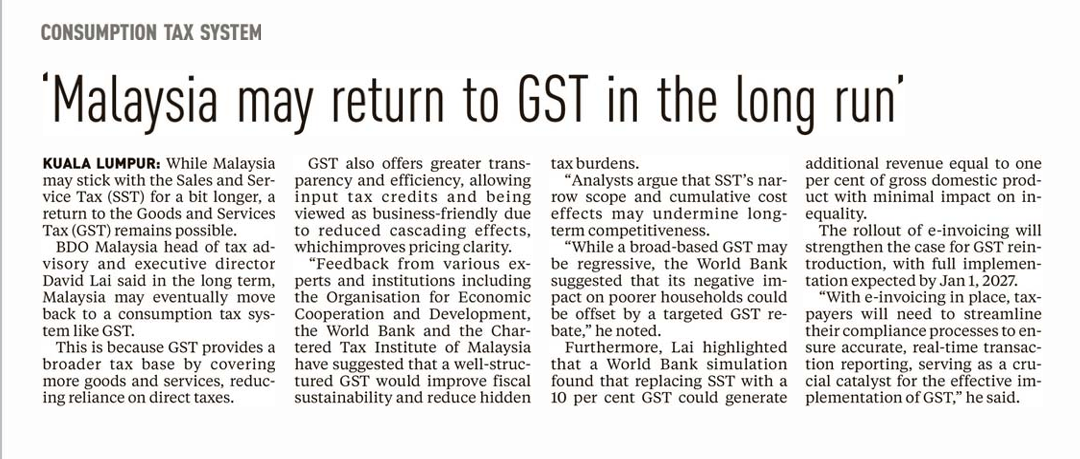
Originally featured in The New Straits Times in print and online on 10 October 2025, based on insights from an interview with David Lai, Head of Tax Advisory and Executive Director, BDO Malaysia, by S. Birruntha.
BDO Malaysia head of tax advisory and executive director David Lai said in the long term, Malaysia might eventually move back to a consumption tax system like GST.
This is because GST provides a broader tax base by covering more goods and services, reducing reliance on direct taxes.
GST also offers greater transparency and efficiency, allowing input tax credits and being viewed as business friendly due to reduced cascading tax effects, which in turn improves pricing clarity.
"Feedback from various experts and institutions including the Organisation for Economic Cooperation and Development, the World Bank and the Chartered Tax Institute of Malaysia has suggested that a well-structured GST would improve fiscal sustainability and reduce hidden tax burdens.
"Analysts argue that SST's narrow scope and cumulative cost effects may undermine long-term competitiveness.
"While a broad-based GST may be regressive, the World Bank suggested that its negative impact on poorer households could be offset by a targeted GST rebate," he noted.
Furthermore, Lai highlighted that a World Bank simulation found that replacing SST with a 10 per cent GST could generate additional revenue equal to one per cent of gross domestic product with minimal impact on inequality.
The rollout of e-invoicing in Malaysia strengthens the case for GST reintroduction, with full implementation expected by Jan 1 2027.
"With e-invoicing in place, taxpayers will need to streamline their compliance processes to ensure accurate, real-time transaction reporting, serving as a crucial catalyst for the effective implementation of GST," he said.
Originally featured in The New Straits Times in print and online on 10 October 2025, based on insights from an interview with David Lai, Head of Tax Advisory and Executive Director, BDO Malaysia, by S. Birruntha.